Saturday, July 19, 2025

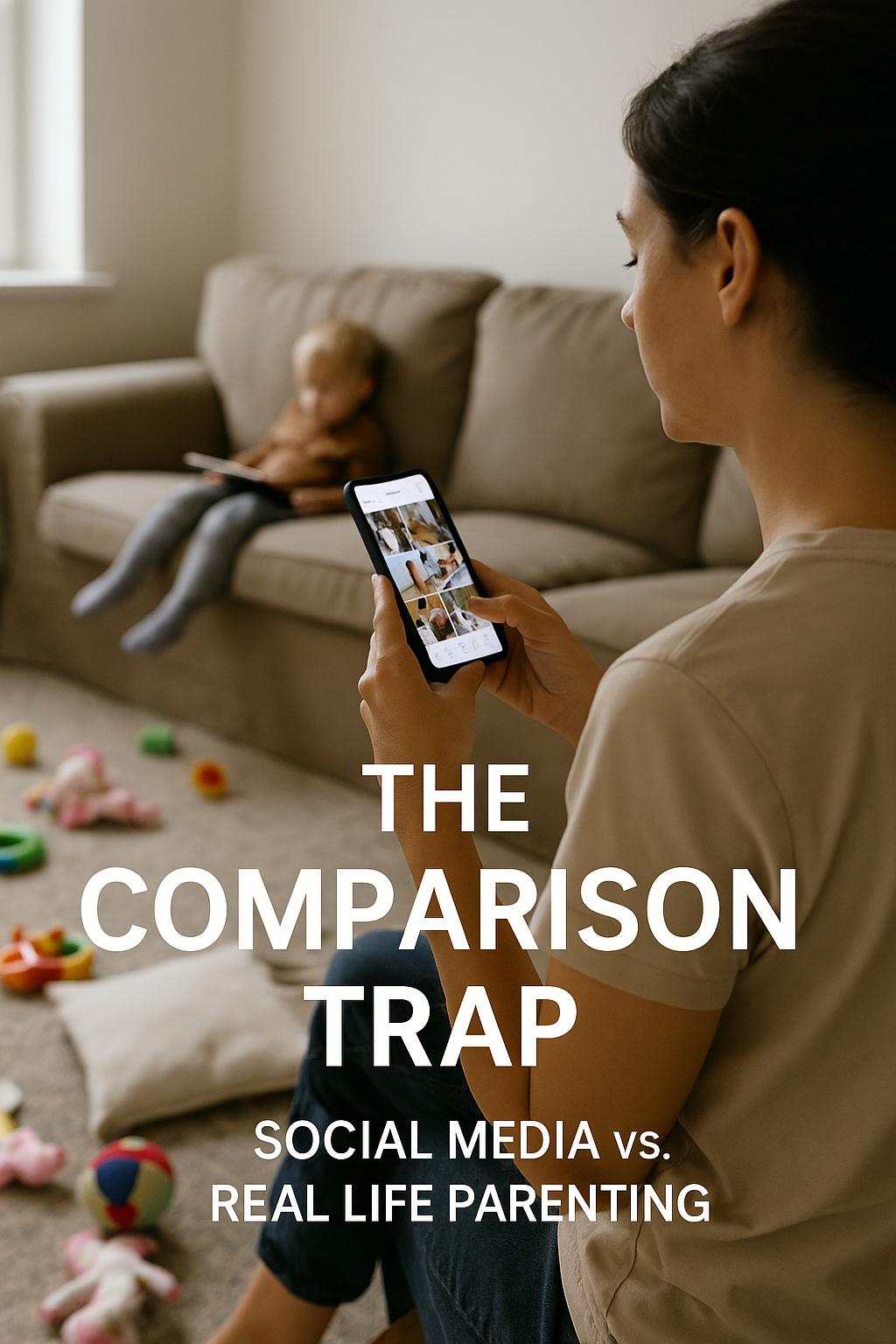
The Comparison Trap – Social Media vs. Real Life Parenting

We all know we shouldn’t compare ourselves to others—but that doesn’t stop it from happening, especially when social media is involved. One scroll through Instagram or Pinterest can make you feel like everyone else is doing it better: cleaner homes, more patient parenting, better routines, more smiles, fewer meltdowns. But here’s the truth:

You’re seeing their highlight reel, not their reality.

Filters Don’t Show the Mess

That perfectly staged photo of a toddler playing quietly in a spotless living room? What you didn’t see was the toy explosion shoved behind the camera and the tantrum that happened ten minutes before. Most of us don’t share the hard moments, which means what you’re comparing yourself to doesn’t even exist.

Everyone Has Struggles—Even the “Perfect” Ones

Even the parents who seem to have it all together have bad days, sleepless nights, and moments where they feel like they’re failing. Just because they don’t post about the chaos doesn’t mean it isn’t there.

Your Kids Don’t Need Pinterest-Perfect

They don’t need themed lunches, coordinated outfits, or elaborate crafts. They need you—present, loving, and trying your best. The moments your kids will remember aren’t the ones that look the best in photos. They’re the ones where they felt seen, heard, and loved.

You’re Doing Better Than You Think

You are not behind. You are not failing. You’re raising tiny humans in a messy, beautiful, overwhelming world. The work you’re doing matters—even if it never goes viral.


Let’s stop measuring our worth against someone else’s feed. You are more than enough, exactly as you are—even on the days that don’t look “aesthetic.”

Saturday, July 12, 2025

Gentle Parenting Without Losing Your Mind

Let’s be honest—gentle parenting sounds lovely in theory. Soft voices, peaceful redirection, emotional intelligence out the wazoo. Who wouldn’t want to raise kind, confident kids in a calm, respectful home?

But what happens when your toddler hurls a toy at your face for the third time that morning, your coffee’s gone cold again, and your inner gentle parent feels like she’s curled up in the fetal position muttering, “Use your words, use your words…”?

Gentle parenting is a beautiful goal—but it’s also really hard sometimes. And that’s okay. You can embrace connection and compassion without becoming a doormat or pretending to be calm when you're secretly a volcano in leggings.

Here’s how to approach gentle parenting in a way that’s realistic, sustainable, and doesn’t leave you sobbing into your laundry pile.


You’re Allowed to Have Emotions Too

One of the biggest myths about gentle parenting is that you’re not allowed to be angry, frustrated, or overwhelmed.

Spoiler alert: you’re human.

Gentle parenting isn’t about never raising your voice or never losing your cool. It’s about modeling repair when those things happen. So when you snap, take a breath, and then say, “I got really frustrated, and I yelled. I’m sorry. I’m working on it.”

That alone is powerful. You're not ruining your child—you’re teaching them how to own their actions and come back to connection. That’s gentle parenting too.


You Can Set Boundaries AND Be Gentle

Some people think gentle parenting means being permissive or saying “yes” all the time. But here’s the truth:

“No” is not a dirty word.

You can set boundaries with kindness and clarity. You can say, “I won’t let you hit me,” or “You can be angry, but you may not throw things,” without shame or punishment.

It’s not about ignoring behavior—it’s about responding in a way that teaches instead of threatens.

Your job isn’t to control your child—it’s to guide them. And sometimes that means holding the line calmly while they fall apart beside you. (And yes, that’s as exhausting as it sounds. But it matters.)


Gentle Doesn’t Mean Weak

Repeat after me: Being gentle doesn’t mean being passive.

It takes serious strength to stay steady when your kid is melting down. It takes courage to look beneath the behavior and ask, “What do they need right now?” instead of just barking, “Go to your room!”

You’re not being too soft. You’re being intentional.

You’re showing your child that love doesn’t disappear when things get hard. You’re teaching emotional resilience—not through lectures, but through how you show up.

And if you mess that up sometimes? Welcome to the club. We have snacks and zero judgment.


Let Go of the Pressure to Be Perfect

Gentle parenting is a toolbox, not a checklist. You’re going to have days where you yell, days where you bribe with screen time, days where dinner is Goldfish crackers and string cheese. That doesn’t cancel out all the connection and care you’ve offered.

Kids don’t need perfect parents.

They need parents who try, who repair, who show up over and over again.

So let go of the guilt. Let go of the Pinterest-perfect ideal. You’re already doing more than enough by caring how you show up.


Fill Your Own Cup (Yes, Really)

It’s hard to be gentle when you’re running on empty.

If you’re constantly pouring from a dry cup, eventually something’s going to crack (probably your voice—or a plate). Gentle parenting without self-care turns into resentment fast.

Self-care doesn’t have to mean spa days or solo vacations. It might mean five minutes of silence in the bathroom, texting a friend who gets it, or eating a snack that doesn’t have someone else’s bite marks in it.

You matter. Your mental health matters. And your kid will actually benefit from seeing you take care of yourself.


Closing Thoughts: You Don’t Have to Be a Zen Master

Gentle parenting isn’t about perfection—it’s about connection.

It’s about slowing down when you can, apologizing when you need to, and remembering that both you and your child are learning as you go.

You’re allowed to mess up. You’re allowed to be tired. You’re allowed to take a break, regroup, and try again tomorrow.

And if all else fails? Whisper a gentle “Mommy needs a snack and a nap” and start fresh.

You’ve got this—even if your version of gentle parenting includes the occasional “OH FOR THE LOVE OF—” behind a closed door.
Friday, July 4, 2025

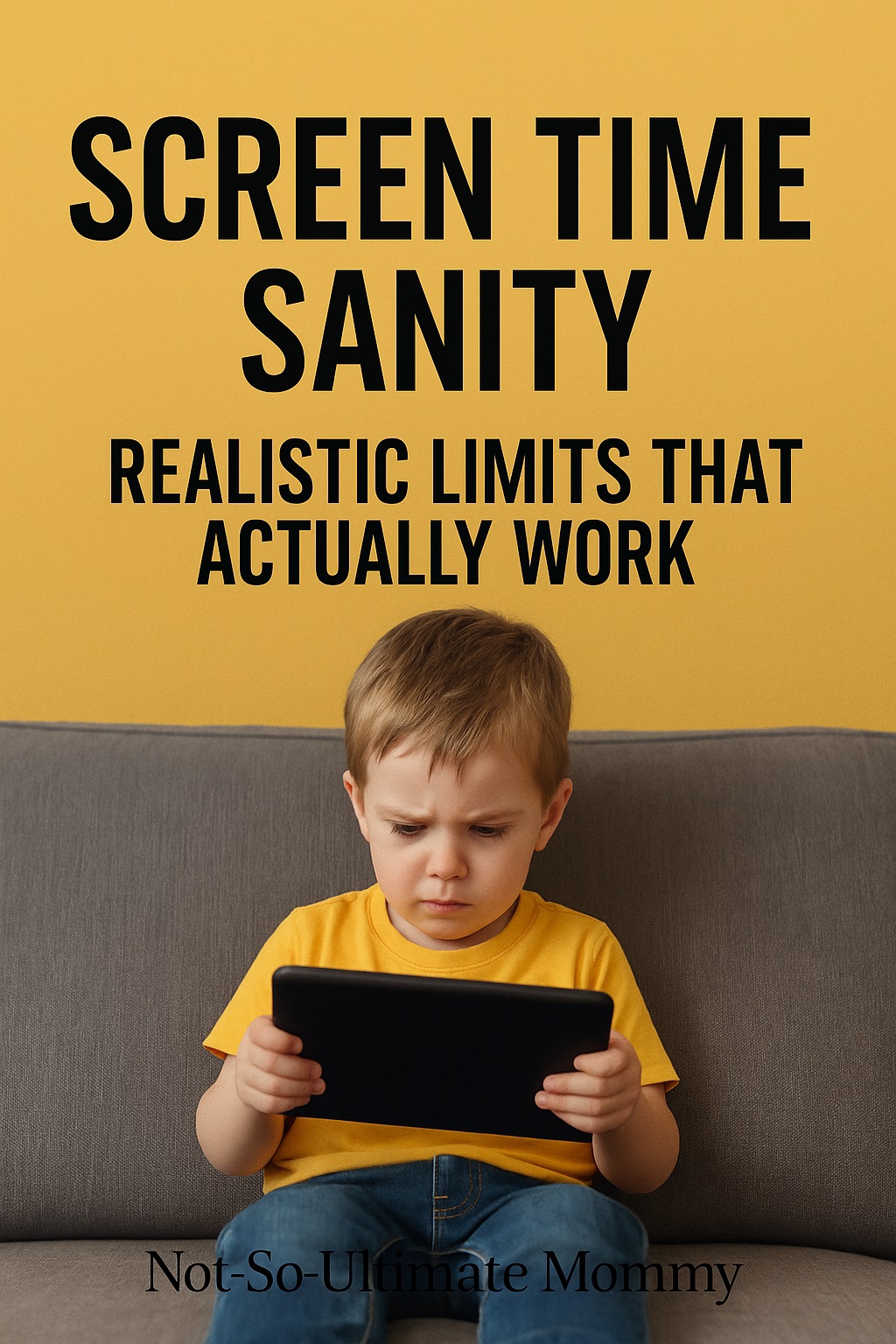
Screen Time Sanity – Realistic Limits That Actually Work

Let’s be honest: screen time gets a really bad rap in the parenting world. Spend five minutes in a mom group and you’ll find someone declaring that kids shouldn’t have any screen time, ever. That the TV is rotting their brains. That iPads are turning toddlers into zombies. That “back in my day” we played with sticks and imagination and liked it.

You know what else we didn’t have back then? A global pandemic, remote schooling, constant work-from-home demands, or the intense pressure of 24/7 parenting with limited support. So let’s start by throwing a little compassion into the screen time conversation—because this isn’t about guilt. It’s about balance.

The Truth About Screen Time

We don’t live in a screen-free world. Technology is part of our kids’ reality—and it’s not all bad. Educational shows teach letters and numbers. Interactive games build problem-solving and motor skills. And yes, sometimes a quiet cartoon is the only thing standing between you and a full-blown parental meltdown.

But just because screens aren’t inherently evil doesn’t mean they should be unlimited.

The key is intentional use—setting boundaries, staying engaged, and understanding the why behind your screen time decisions.

What Screen Time Looks Like in a Real-Life Household

In our house, screen time isn’t a taboo topic. We don’t act like it’s a forbidden treat or an inevitable sin. It’s a tool—one we use with intention, and one we monitor closely. Here’s what that actually looks like:

  • Set time limits that vary by age, activity, and behavior. Sometimes it’s 30 minutes after school. Sometimes it’s a movie night with popcorn and blankets. Other times it’s a hard “no,” especially if screen time has been turning our kids into tiny rage monsters.
  • Pick quality content. Not all screen time is equal. We steer away from mindless toy unboxing videos or content with endless ads and no educational value. Instead, we look for shows and games that teach something—social skills, letters, science, empathy. And we watch together, at least some of the time.
  • Use screen time as a bridge, not a babysitter. Do we sometimes hand over the tablet so we can make dinner or pee in peace? Absolutely. But we try not to use it as a constant placeholder for parenting. Screens are a break—not a substitute.
  • Talk about what they see. If our kids watch a show, we ask questions. “Why do you think that character felt sad?” “What would you do if that happened to you?” It turns passive screen time into a shared experience.

How to Set Limits Without Losing Your Mind

Setting screen time rules doesn’t have to be a constant battle. Here are a few tricks that actually work (most of the time):

1. Use timers.

Let the timer be the bad guy. Set a kitchen timer or use the one built into the tablet. When it goes off, screen time is done—no negotiation. The timer said so.

2. Create a screen schedule.

Have “screen days” and “no-screen days” or certain hours where screens are allowed. The structure helps kids know what to expect and removes a lot of the whining.

3. Earned screen time.

Incentivize screen time with other activities. “When your homework is done, you can have 30 minutes of TV.” Or, “Let’s clean up the toys and then pick a show.”

4. Model good habits.

This one’s hard, but important. If we’re constantly glued to our phones, it sends a mixed message. Kids notice more than we think.

5. Replace, don’t just remove.

If you’re cutting back on screen time, replace it with something. Coloring, crafts, outside play, audiobooks, puzzles, fort-building, baking—anything that captures attention and doesn’t require charging.

When Screen Time Becomes a Problem

Sometimes, even monitored screen time causes issues. Maybe your child becomes super cranky after watching certain shows. Maybe they start refusing to do anything else. Maybe screen time battles turn into full-scale wars.

If that’s happening, it’s time to reassess. Not all kids react the same way. Some are more sensitive to overstimulation. Some shows are more dysregulating than others. It’s okay to say, “This isn’t working right now,” and take a break.

And don’t be afraid to bring in professional help if needed. There’s no shame in getting support from a pediatrician, occupational therapist, or counselor—especially if screen struggles are affecting your child’s mood or behavior long-term.

Let’s Talk About the Guilt

We need to stop pretending that a little screen time makes you a bad parent.

You’re not ruining your kid because you turned on Bluey so you could drink coffee before it got cold. You’re not failing because your child plays a math game on the iPad while you clean the kitchen. You’re not doing it wrong because your house doesn’t look like a Waldorf Pinterest board.

Parenting is hard. Screens are part of the modern toolbox. What matters is how you use them—not that you use them.

Final Thoughts

Realistic screen time limits aren’t about banning screens or feeling guilty every time your child touches a tablet. They’re about making thoughtful choices, staying involved, and finding what works for your family—not someone else’s.

You know your kids better than anyone else. You get to decide what’s healthy, what’s manageable, and what makes your life just a little bit easier.

And if that means an episode of Paw Patrol while you shower in peace? That’s not failure. That’s smart parenting.

Friday, June 27, 2025

Mom Brain Is Real – And Here’s How I Cope With It

There’s a moment in every mom’s life when she finds her coffee in the microwave… from yesterday. Or she walks into a room and immediately forgets why she’s there. Or calls every child in the house by the wrong name—including the dog—before landing on the right one. Welcome to the glamorous world of Mom Brain—population: all of us.

Let’s just get this out of the way: Mom Brain is real. It’s not imaginary. It’s not just an excuse we use when we forget it’s Pajama Day at school (again). It’s a very real, very common side effect of having your brain hijacked by tiny humans and their endless snack needs.

I used to be able to juggle deadlines, hold intelligent conversations, and remember where I parked the car. Now I’m lucky if I can finish a sentence without being interrupted by a shriek from the other room and a suspicious crash. So if you, too, find yourself wandering aimlessly through the house with one sock on and a sippy cup in your purse, just know: you’re not alone—and you’re not broken.

Let’s talk about what causes Mom Brain, how it shows up, and most importantly, how I manage to stay (mostly) functional despite it.


What Exactly Is Mom Brain?

Scientifically speaking? It’s a combination of sleep deprivation, hormonal changes, mental overload, and the constant state of low-key crisis management that defines motherhood. Emotionally speaking? It’s like your brain has 82 browser tabs open at once, and you have no idea where the music is coming from.

There’s a lot of talk about “baby brain” during pregnancy, but nobody really warns you that it doesn’t magically go away once you give birth. In fact, it sometimes sticks around for years. YEARS. You know why? Because you don’t stop needing to remember all the things. You just add new things to remember on top of the old things. Doctor appointments. Birthday parties. Whether the dog got fed. Whether you got fed.


What It Looks Like in Real Life

  • Walking into a room with a purpose… and walking back out again with a handful of Legos and no memory of what the purpose was.
  • Asking your child where your phone is because you were using it… to look for your phone.
  • Saying “Just a minute!” 47 times and then forgetting what they asked for in the first place.
  • Calling your kid by your sister’s name. Or your cat’s name. Or your own name.
  • Putting the milk in the pantry and the cereal in the fridge. (Just me?)

It’s not that we’re not smart. We are. It’s just that our brains are overclocked 24/7 and running on a system that thinks goldfish crackers count as a complete meal.


How I Cope (Most Days)

I wish I could tell you I found the secret—some magical formula that makes it all better. But truthfully? Coping with Mom Brain is less about fixing it and more about working with it.

1. Write it down. Immediately. On everything.

Sticky notes, phone alarms, whiteboards, the back of my hand—if it’s not written down, it’s gone. I have accepted that my memory is no longer a reliable place to store anything. I leave myself little notes like “CHECK LAUNDRY” and “YOU HAVE A CHILD IN THE BATHTUB.” Post-it notes are my love language now.

2. Embrace the calendar.

I live and die by my calendar app. If it’s not on the calendar, it isn’t happening. Soccer practice? On the calendar. Garbage day? On the calendar. The thing where I promised to bring gluten-free cupcakes to school even though I don’t know how to bake gluten-free cupcakes? Also on the calendar… with a reminder the day before so I have time to panic.

3. Prioritize sleep (as much as possible).

Okay, this one is hard. I know. Sleep feels like a luxury, especially if you’ve got a baby, a night owl, or a child who randomly wakes you up at 3 a.m. to tell you they can’t find their sock. But when I do manage to sleep, I notice a huge difference in how foggy my brain is. So I try. And when I can’t, I forgive myself and drink a lot of coffee.

4. Lean into the funny.

There are two options: laugh or cry. And frankly, I don’t have time to redo my makeup. So I laugh. I make jokes about calling the dog by my kid’s name. I laugh when I find the TV remote in the fridge. Because if I don’t laugh, I might spiral—and nobody wants that.

5. Ask for help.

This one took me a while. I thought I had to do it all, remember it all, be it all. But asking for help isn’t weakness—it’s teamwork. If I forget the dentist appointment, I’m not ashamed to call and reschedule. If I can’t remember what I went to the store for, I call home and ask. Sometimes, I even ask my kid. They usually remember better than I do.

6. Lower the bar.

The bar for success used to be color-coded binders and a meal plan. Now? It’s keeping the kids alive and only microwaving my coffee twice before drinking it. If I make it to bedtime with everyone fed, hugged, and relatively clean, that’s a win. The rest? Optional.


It’s Not Just You

Mom Brain can feel isolating. It can feel like everyone else has it all together while you’re just trying to remember where you put your keys (hint: check the freezer). But let me tell you something important: this is normal. You are not failing. You are just a mom.

A mom whose brain is doing overtime while also juggling emotions, logistics, and probably a handful of Cheerios. A mom whose mental to-do list is so long it wraps around the block. A mom who cares deeply, tries hard, and still sometimes forgets what day it is.

And you know what? That’s okay.


One Last Thing

If you made it all the way to the end of this post without getting distracted by a tiny voice yelling “Mooooom!”—I salute you. If you did get distracted three times and came back to finish later? I see you. You’re my people.

Mom Brain is real. But so is your strength, your humor, and your resilience. You’re doing great. And if all else fails, check the microwave. Your coffee’s probably in there.