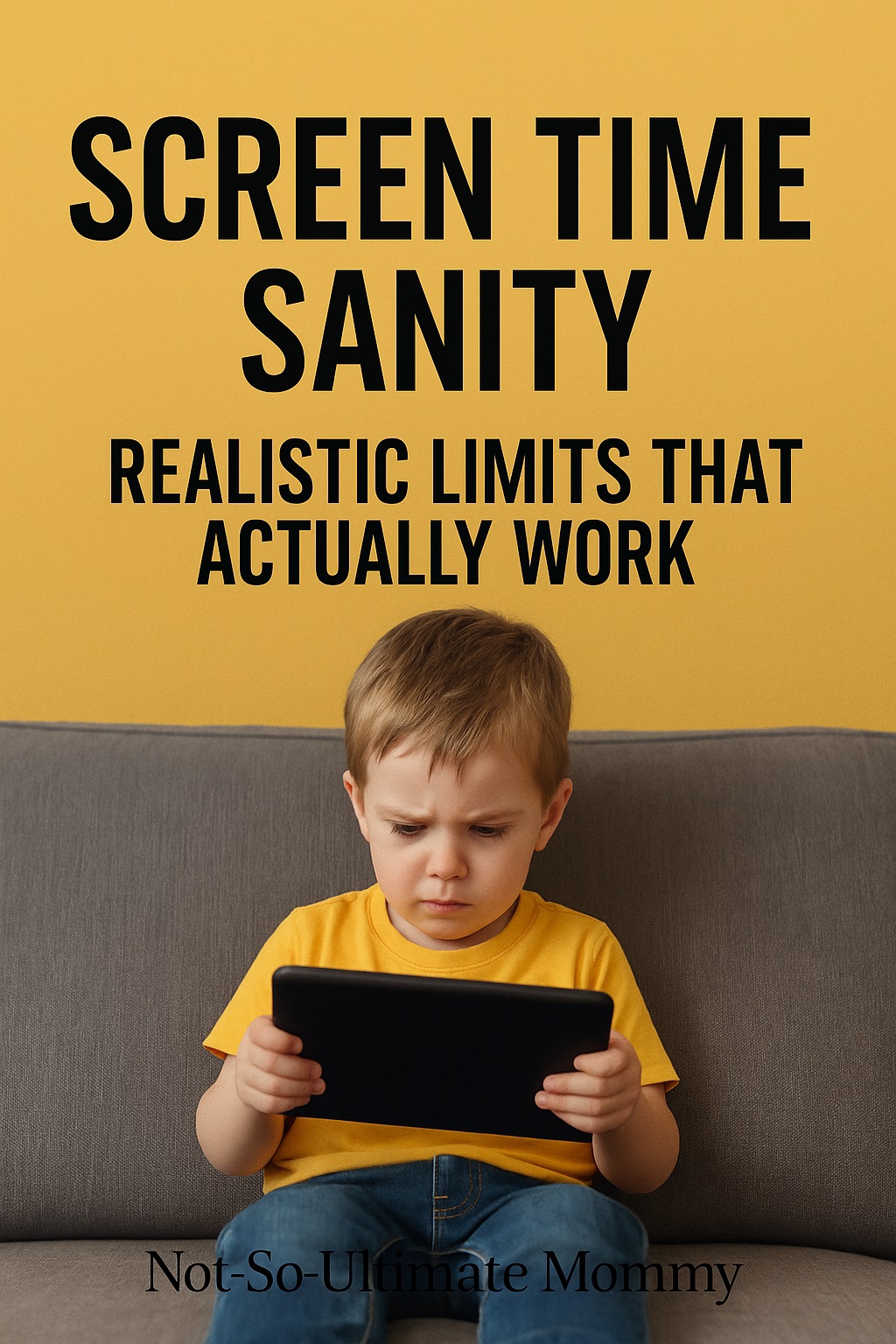
“Screen time is not the enemy… it’s the co-parent we don’t talk about.”
There. Doesn’t that feel better?
Somewhere out there, a perfectly serene parenting expert is announcing that children should have no more than 22 minutes of screen time per week, preferably while sitting upright on the floor consuming a wholesome snack carved from organic, hand-foraged vegetables. Meanwhile, the rest of us are tossing tablets at our kids like Olympic athletes and whispering a prayer that Paw Patrol buys us 20 uninterrupted minutes to cook dinner, answer emails, or simply sit in silence and remember who we are as human beings.
Let’s get honest. Real moms don’t just “allow” screen time — we survive with screen time.
And that’s okay.
~
Why Screen Time Became the Modern Mom’s Lifeline
If you’ve ever tried to get anything done with small children underfoot, you know the truth: kids don’t just want attention — they want your soul, immediately and at full capacity.
Need to pee? They’ll follow you.
Need to fold laundry? They’ll climb inside the basket and throw it everywhere.
Need to answer one simple email? Suddenly someone is hungry, someone is sticky, and someone is crying because their sock has wrinkles.
Screens, on the other hand, hold a mystical power. They create blessed moments of stillness. They transform gremlins into content, glazed-eyed cherubs. They allow us to breathe, think, and occasionally shower.
Screens didn’t become a parenting crutch because moms are lazy. Screens became a lifeline because modern parenting demands the time and attention of three full-grown adults. Technology simply fills the gap the village used to fill.
~
The Fantasy vs. The Reality
Fantasy:
Your child watches 10 minutes of high-quality, educational content before happily wandering off to build non-toxic crafts from recycled materials.
Reality:
Your child binges 6 episodes of whatever YouTube rabbit hole the algorithm burped up, including a grown man opening mystery eggs and shouting like he just won the lottery.
Fantasy parenting tells us screen time is dangerous and harmful.
Real motherhood says:
“Look, I’m choosing between letting them watch cartoons or completely losing my mind, so… hand me the remote.”
~
Let’s Talk About the Guilt
There’s a special kind of guilt that lives deep in the heart of a mom who has exceeded the recommended daily screen time limit — which, by the way, is apparently 0.4 seconds according to some experts.
But let’s be clear:
Guilt has never folded laundry.
Guilt has never balanced a budget.
Guilt has never cooked dinner while breaking up a sibling argument and ensuring the toddler doesn’t fall off the couch.
What does help?
A screen.
Screens don’t replace parenting. They simply support us in the moments we cannot perform at Olympic levels.
And if you’ve ever heard another mom mention “no screen time in our home,” remember:
- She is either lying,
- She owns furniture somehow immune to spilled yogurt, or
- She only has one child and that child is five minutes old.
~
Different Moms, Different Rules
Here’s the secret: there is no universal screen-time rule among real moms. There are only survival strategies.
Some moms limit screens to weekends.
Some moms use them during dinner prep.
Some moms use them at bedtime.
Some moms hand over a tablet anytime someone so much as whispers “I’m bored.”
And some days, all rules simply evaporate because the toddler is teething, someone is sick, or you’ve hit your emotional limit and need the mental equivalent of a soft pillow and a locked bathroom door.
Whatever your system looks like — if it works for you and your kids, it’s the right one.
~
When Screens Become the Teacher, the Babysitter, and the Peacekeeper
Let’s be brutally honest: screens do more than entertain. They educate, too.
Kids learn letters, numbers, languages, empathy, songs, stories, and problem-solving skills. Screen time presents worlds we could never build in our living rooms (unless you own a life-size replica of a pirate ship, in which case… invite me over).
Screens help kids unwind when their brains are overloaded. They offer comfort and consistency. They let kids explore.
And yes — they also give us 10 minutes to drink a coffee that isn’t ice cold.
~
The “Mom Math” of Screen Time
Every mom knows this math. It’s instinctive:
- One episode of a cartoon = enough time to cook a full meal.
- Two episodes = enough time to clean the kitchen and check three emails.
- A full movie = long enough for a nap where you lie perfectly still with one eye open, listening for suspicious silence.
And on special occasions (doctor visits, migraines, stomach flu, mental health days)?
We break out the big guns: “Watch whatever you want. I love you. Just don’t set the house on fire.”
~
When Screen Time Becomes the Fight
Even though we logically know screen time is a tool, there’s still the daily battle of turning it off.
Kids never say, “Oh yes, Mother, I believe I’ve had a wholesome and appropriate amount of passive stimulation today.”
No.
They say:
“That was my FAVORITE EPISODE EVER, WHY WOULD YOU RUIN MY LIFE?!”
Then they crumble like soggy crackers.
So we negotiate.
We bribe.
We rely on timers and countdowns and threats of “If you scream one more time, the tablet goes away forever and I mean FOREVER.”
And somewhere in the background, an educational expert with no children tells us that “transition cues” should be enough.
Bless their hearts.
~
When Do We Actually Worry About Screen Time?
Despite the jokes, there is one valid reason to pay attention to screen habits: balance.
Not perfect balance — this isn’t a yoga retreat — but enough balance.
Do they still play with toys?
Do they get outside sometimes?
Do they sleep?
Do they eat real food a few times a day?
Do they smile, laugh, and occasionally run around like caffeinated squirrels?
If yes, then screen time hasn’t stolen your child’s soul. You’re doing an amazing job.
~
Screens Don’t Make Bad Moms — Unrealistic Expectations Do
The truth is:
We are raising children in a world that’s very different from the one we grew up in. Screens aren’t just entertainment — they’re part of the culture, part of education, and part of communication.
Kids who use screens aren’t damaged.
Moms who allow screens aren’t failing.
Families aren’t broken because the TV is on while you fold laundry.
What does hurt moms is shame — the feeling that we’re never doing enough, never being enough, never measuring up.
But your love, consistency, patience, and late-night snuggles matter far more than how many minutes someone watched Bluey today.
~
The Real Screen Time Confession
So here it is — the confession that unites real moms everywhere:
We use screens.
We use them daily.
Sometimes we rely on them.
And sometimes they save us.
And guess what?
Our kids still grow, learn, play, laugh, and love with full hearts.
Because what matters is not the screen itself — it’s the mom behind the screen time, doing her best every single day.
And that mom?
She’s incredible.